

KS2 SATs & the 11+:
A Parent’s Guide to Years 5 and 6

Personalised learning
for every student
and every goal
Personalised learning
for every student
and every goal
KS2 SATs and the 11+ Maths Exam: A Parent’s Guide to Preparing Your Year 5–6 Child
For many families, Year 5 and Year 6 mark the beginning of one of the most important academic milestones in a child’s early education.
KS2 SATs and, for those pursuing a grammar school place, the 11+ maths exam. Both assessments carry real weight — SATs results help shape a child’s secondary school pathway, while 11+ success can open the door to some of the country’s most sought-after selective schools. Understanding what each exam actually involves, and how to prepare for both without overwhelming a young learner, is one of the most common questions we hear from parents.
Understanding KS2 SATs Maths: What It Covers and Why It Matters
KS2 SATs are taken by all Year 6 pupils in England during May and consist of an Arithmetic paper and two Reasoning papers. The Arithmetic paper tests calculation fluency — addition, subtraction, multiplication, division, fractions, percentages and order of operations — completed at pace and without a calculator. The Reasoning papers go further, requiring pupils to apply those same skills to worded problems, multi-step questions and unfamiliar contexts.
Although SATs do not determine which secondary school a child attends, results are used by secondary schools to understand a pupil’s starting point and are increasingly referenced during transition. More importantly, strong SATs performance reflects genuine mastery of the primary maths curriculum — a foundation that pays dividends well beyond Year 6, right through to GCSE.
The 11+ Maths Exam: How It Differs from SATs
While SATs and the 11+ overlap in curriculum content, the 11+ maths exam is a different challenge altogether. Depending on the local authority or consortium, papers are typically set by GL Assessment or CEM (now part of the Centre for Evaluation and Monitoring), each with its own question style, timing and format. Compared with SATs, the 11+ tends to demand:
- Greater speed — questions must be answered under tighter time pressure, often in a multiple-choice format.
- Less familiar problem types — puzzles, sequences and logic-based questions sit alongside standard curriculum topics.
- Independent exam technique — many 11+ papers are designed to be unpredictable by nature, testing how a child copes with the unexpected as much as what they know.
This is why a child who is comfortably “secondary ready” for SATs can still find the 11+ demanding without targeted preparation. The two exams reward different skills, and treating them as identical often leaves gaps in a child’s readiness.

Verbal and Non-Verbal Reasoning: The Often Overlooked Skill
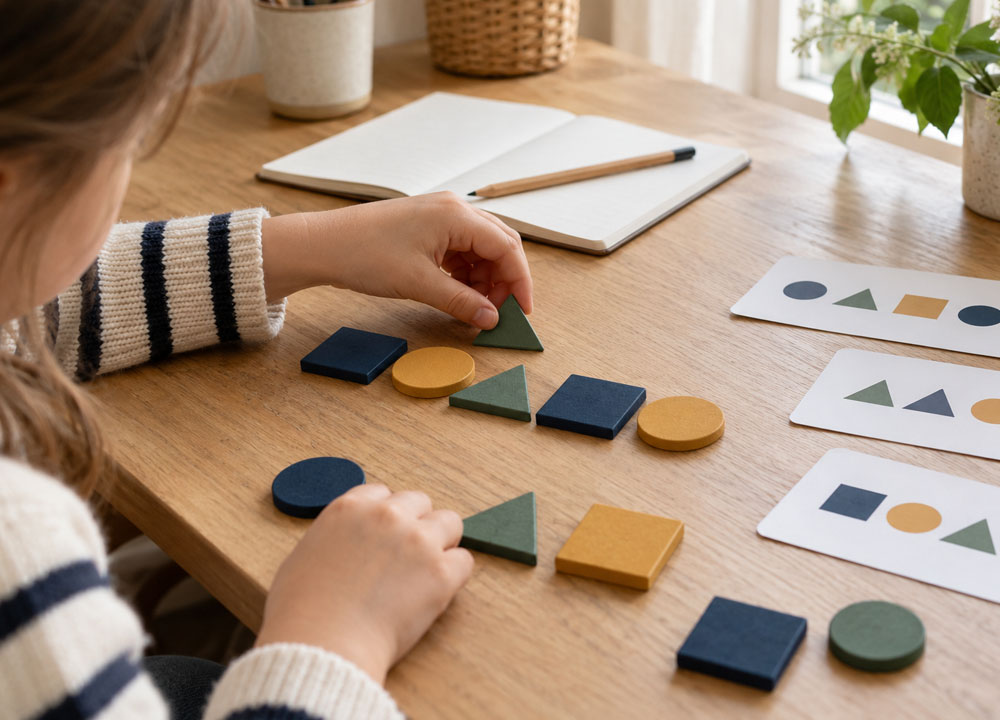
For families in London and the wider Home Counties targeting grammar schools — whether in outer London boroughs, Kent, Buckinghamshire or Essex — verbal and non-verbal reasoning frequently appear alongside the maths and English papers. These sections test pattern recognition, logical sequencing and abstract problem-solving, skills that are rarely taught explicitly in the primary classroom. Far from being a side note, strong reasoning ability often underpins success across the whole 11+ assessment, since the same logical thinking applies directly to non-routine maths questions. Preparing a child specifically for reasoning, rather than assuming it will simply “come naturally,” is one of the most effective uses of tuition time in the run-up to exams.
When Should Preparation Start?
There is no single correct answer, and it depends entirely on the individual child. That said, a few general principles apply:
- Year 4 or early Year 5 is an ideal window to begin building strong foundational fluency without exam pressure, particularly for children who need more time to consolidate core number skills.
- Mid-to-late Year 5 is when most structured 11+ and SATs-focused preparation begins in earnest, allowing a full academic year before exams.
- Later starts in Year 6 are still worthwhile, particularly for children who are already strong mathematically and simply need exam technique, timed practice and confidence-building.
The right pace is one that stretches a child without causing anxiety — a balance that is far easier to strike with an experienced tutor who can adjust the plan as progress is made.
Why One-to-One Tuition Makes the Difference
Group “11+ crammer” classes are common across West and Central London, but they can only move at the pace of the group, and a one-size-fits-all approach rarely suits every child equally. One-to-one tuition, by contrast, allows lessons to be built entirely around a child’s own strengths, gaps and learning style — whether that means slowing down to secure fundamentals, accelerating through familiar topics, or spending extra time on reasoning technique where it’s needed most.
At Mr Coach – Tutoring & Education, every Young Learner begins with an initial assessment to understand their current level before a tailored programme is designed. Lessons are paced to suit the individual, with a clear emphasis on building genuine mathematical understanding and logical reasoning skills, alongside the confidence and positive study habits that make exam success sustainable rather than stressful.
Supporting Your Child Through the Process
Parents play an important role beyond arranging tuition. A few practical suggestions that we regularly share with families:
- Keep early preparation light and low-pressure — confidence built early pays off later.
- Celebrate effort and improvement, not just correct answers.
- Maintain a normal school and home life alongside tuition; burnout is far more damaging than a slower pace.
- Communicate regularly with your tutor about how your child is coping, both academically and emotionally.


Frequently Asked Questions
How many tuition sessions are typically needed before the 11+ or SATs?
This varies considerably by starting point, but many families begin with weekly sessions a year or more in advance, increasing frequency closer to exams.
Does tuition help with SATs even if my child isn’t sitting the 11+?
Yes — the underlying skills of fluency, reasoning and problem-solving benefit any Year 6 pupil, regardless of which exams they sit.
Is tuition available in person and online?
Both. In-person lessons are available across West and Central London, including Kensington, Chelsea, Hammersmith, Fulham and Westminster, alongside online tuition for families further afield.
Get in Touch
If you are looking for experienced, one-to-one support to help your child approach KS2 SATs or the 11+ with confidence, Mr Coach – Tutoring & Education would be delighted to help. With a PGCE and IB-trained tutor bringing over 15 years of teaching experience, a tailored learning plan, and a genuine commitment to making maths enjoyable, we are a trusted choice for London families navigating this important stage. Contact us today to discuss your child’s needs and find out how we can support their journey towards SATs and grammar school success.

Build your personalised learning journey to achieve your own GCSE and A level maths goals with expert guidance from Mr Coach
Tailored tuition with a private GCSE and A level maths tutor enhances your learning power through customised lessons and provides the best foundations to achieve your goals, and go on to explore the wide range of STEM career opportunities available. Contact us today to book your tuition spot.

